Epistemological foundations: Toward a Re-Foundation of a Contemporary Qur’anic Epistemology

Introduction
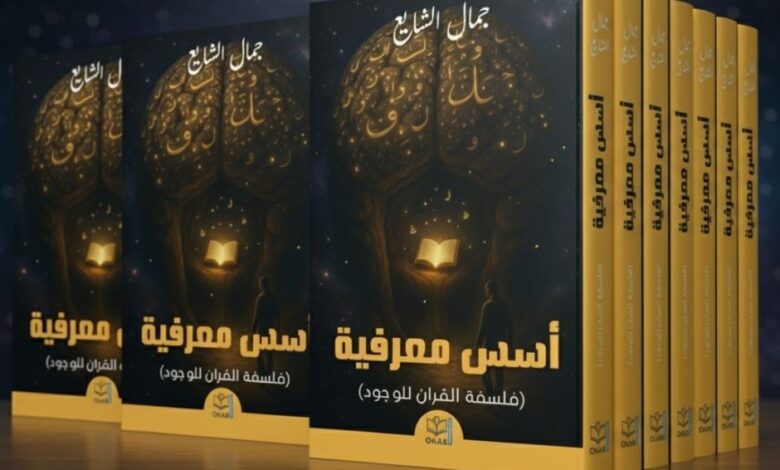
The book Epistemological Foundations (The Qur’anic Philosophy of Existence ) by the Saudi intellectual Jamal al-Shayeh represents a bold foundational attempt to reconstruct the conceptual system that was formed through centuries of exegetical and jurisprudential accumulation. The author argues that the crisis of Islamic thought lies not so much in the lack of evidence or evidence as in the imbalance of the methodology;the narrative and jurisprudential heritage overshadowed the Qur’anic text, distorting its connotations and producing perceptions that contradict the founding values of human existence. The book seeks to reread Qur’anic concepts through the mechanisms of internal analysis of the text, the Arabic language, and rational proof, in order to re-establish a new epistemology that allows for a contemporary understanding of both the Qur’an and reality.
Cognitive approach
Alshaya’s project is based on three main pillars:
The Arabic language: By extrapolating words, going back to the roots and analyzing the literal structure to understand the original connotation, away from the accumulation of heritage dictionaries.
Internal structural analysis: By studying concepts in the network of different Qur’anic contexts and linking them to textual clues.
Rational proof and the value scale: No meaning is accepted that contradicts the values of mercy, justice, justice, and knowledge as divine standards governing existence and knowledge.
With this approach, al-Shaya lays the foundation for a reading that restores the Qur’an’s epistemological centrality, away from the authority of narration and consensus as formulated by traditional schools of thought.
Redefining Central Concepts
Islam
Alshaya defines Islam as surrendering to peace, that is, consciously engaging in a value system based on human coexistence and harmony. Islam is not a historical identity or a formal ritual, but a civilizational act based on the system of values emphasized in the Qur’an (justice, justice, mercy, mercy, science).
Faith
Faith in the Qur’anic conceptualization is not a mental belief, but a transitive act: Providing security and safety for oneself and others. The believer is the one who secures his surroundings and spreads tranquility in human relations, based on Qur’anic values
Blasphemy
According to Al-Shaya, disbelief is the failure to follow the laws of truth in existence, i.e., ignoring facts despite their clarity and following whim and interest. Kufr is not the absence of belief, but a cognitive and moral behavior based on the rejection of evidence.
Decoys
Shirk is the departure from divine law by involving whim or private interest in the place of legislation and falsely attributing it to God. It is not just a conceptualization of multiple gods, but an epistemological corruption that leads to a distortion of the authority of revelation.
Angels
In his vision, angels are not mythical beings, but rather the
Gin
The book redefines elves outside of popular mythology: An understanding of the dominant active energy that influences reality, i.e. anything characterized by subtle fiery power that has a direct impact on the universe.
The word “God”
Al-Shaya provides a careful linguistic reading of the name of the Majlis, revealing that it means the universal truth and the supreme reference to which all things belong. God is the outcome of existence, and He is the bearer of the values of mercy, justice, justice, and knowledge. All of His names are active attributes in the universe, and we worship Him by following them and activating them in our lives. Criticism of Inherited Sources of Legislation Al-Shaya clearly criticizes the reliance on narrationand consensus as sources independent of the Qur’an. He argues that these authorities have been given authority over the text, despite their internal contradictions and lack of Quranic evidence. He calls for restoring the Qur’an as the first authority, and testing any other source against the criterion of consistency with divine values.
Toward a New Qur’anic Epistemology
The book establishes a new epistemology:
Evidence: Evidence is clear and consistent with the facts.
Libra: Testing meanings according to the founding values (mercy, justice, fairness).
The Arabic language: A tool for analyzing concepts from within the text.
Sunniness of reality: The compatibility of meaning with cosmic and social laws.
The Qur’an becomes not just a text for recitation or ritual, but a foundational reference for both knowledge and action.
Conclusion
Epistemological Foundations is the first part of a four-part project that aims to re-establish Qur’anic epistemology. In this work, Jamal al-Shayeh reviews all major concepts and reformulates them according to the Qur’anic text itself, establishing an alternative vision that moves Islamic thought from the captivity of inheritance to the space of authentic Qur’anic knowledge. It is not only a book of criticism, but a practical step towards a radical renewal in how we understand religion and reality, and reconnecting man with his first reference point: The Book of God.
To obtain this book, please go to the following link to the publishing house of the International Institute for Quranic Studies
Publishing House