
A specialized reading of Yasser Al-Adirgawi’s methodological thesis
Introduction: Beyond the Legacy Wall
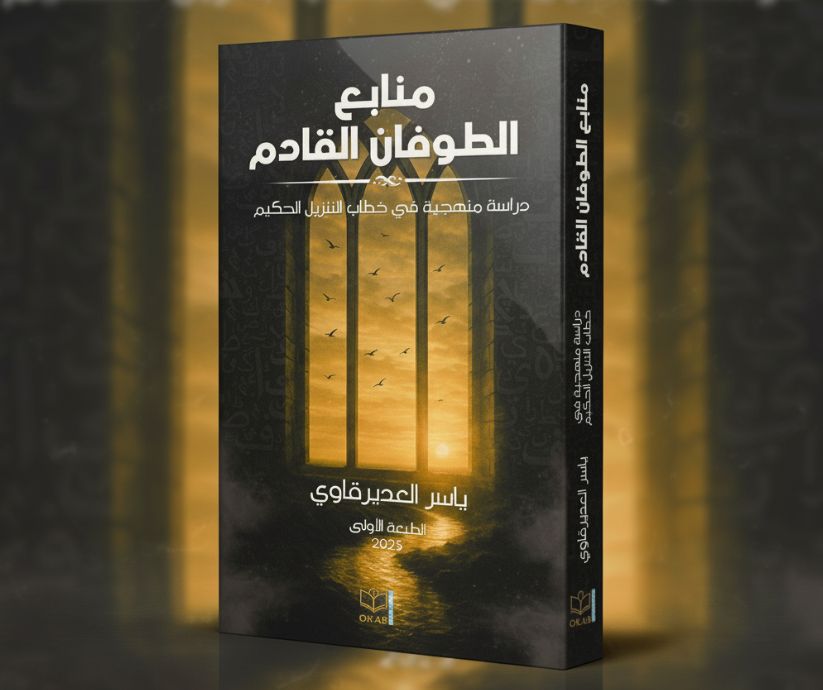
Every year, the Arab and Islamic library witnesses a flood of Qur’anic works and studies, but few of them rise to the level of a “foundational project” or a “shocking thesis” that shakes up the structure of mainstream thinking. The book “Fountains of the Coming Flood (A Methodological Study in the Discourse of the Wise Download)” by Professor Yasser Al-Adirgawi is one of those rare once-in-a-decade works.
Al-Adirgawi does not present himself as a new exegete to add to the long list of exegetes. Rather, he proposes an integrated methodological project to deconstruct the “heritage,” which he believes has formed a dense fence around the Qur’anic text, transforming it from a “living” and active book to a “mummified” text read through the lenses of early exegetes such as Ibn Kathir, Tabari, and Razi.
The importance of the book lies in its title; the “coming flood” in the author’s vision is nothing but the flood of atheism, skepticism, and the collapse of values and morals that is hitting the nation, and he believes that the “sources” of this real flood are the jurisprudential and traditional interpretations that have failed to keep up with the times and have presented a distorted religion. His book presents itself as a “wellspring of a counter-flood”; a flood of new understanding flowing directly from the Qur’anic text itself.
Methodological basis: Deconstruction and construction tools
Al-Adirgawi does not rely on tools from outside the text (such as history) to judge the Qur’an, but rather bases his approach on the fact that the Qur’an carries the tools for reading it within itself. Four basic rules stand out as the author’s “methodological toolkit”:
- Mother rule: No synonyms in the Qur’an (no synonyms in the Qur’an)
The author presents his central rule (the mother rule), which is the “negation of correspondence” between different words in the Qur’an, cleverly distinguishing between “correspondence” which he denies and “synonymy” which he affirms which he affirms. Identicality means the possibility of replacing one word with another without any change in meaning, which the author sees as impossible in a divine text.
Under this rule, “death” is not “death”, “heart” is not “heart”, “wine” is not “drunkenness”, “adultery” is not “fornication”, and “family” is not “parents”. This rule alone is enough to demolish huge jurisprudential pillars built on the confusion of these terms.
- The sanctity of the Qur’anic scripture (Qur’anic scripture)
The author categorically rejects the idea that Qur’anic drawing is the product of scribal misspelling or Ottoman ijtihad. Rather, he asserts that the Qur’anic drawing is “tawqiqi,” meaning that it is an integral part of the revelation, and that every difference in the drawing of a word (deletion, addition, or substitution) carries an additional meaning. The author comes to the bold conclusion that the Qur’anic text was written by the Prophet Muhammad with his own hand, reinterpreting the concept of “illiteracy” as a reference to “Umm al-Qura” or the nation without a book, and not as “ignorance of reading and writing.”
- Redefining “copying”
The author launches a sweeping attack on the traditional concept of “naskh and mansukh” which means “abrogation and disruption”. He argues that this concept is a “fabrication” that ascribes imperfection to God’s words. He proves linguistically and logically from within the Qur’an that “naskh” does not mean abrogation, but rather “bringing a similar copy” or “stabilization and codification”. This rule means that all the verses of the Qur’an (6236 verses) are inerrant and effective, and no verse is inoperative.
- Prophetic Sunnah: “Wisdom” not “second revelation”
The author devotes an entire chapter to discussing the legislative authority of the Sunnah. His conclusion is that the narratives attributed to the Prophet (the so-called Sunnah) are not a “second revelation” parallel to the Qur’an, but rather a “wisdom” that represents the Prophet’s “ijtihad” in applying the Qur’anic text to his historical and social reality.
The term “sunnah” in the Qur’an means “established divine law” (the Sunnah of God). As for the Prophet’s Ijtihad (wisdom), it is an application specific to the generation in which he was “sent” and is not binding on subsequent generations for whom the Prophet is only a “messenger” (informer).
Revolt Against the Axioms: Key findings of the book
Applying this methodology, Al-Adirgawi arrives at results that are considered a real “deluge” on inherited jurisprudence, the most important of which we highlight:
- In penal laws (alleged hudud)
- Apostasy: He emphasizes that there is no earthly punishment for apostates in the Qur’an, and that his punishment is purely eschatological.
- Stoning: He categorically denies the punishment of stoning, considering it to be an Israeli innovation that has been introduced into jurisprudence. He emphasizes that the punishment for “adultery” (which he defines as adultery or incest) is only 100 lashes for both those who are impregnated and those who are not.
- Cutting off a thief’s hand: Rejects the concept of physical “amputation”. It proves that “cutting off the hand” (plural: their hands)
It means “stopping and preventing”; that is, confiscating the instruments of the crime, imprisoning him (cutting off his movement), or dismissing him from his job (cutting off his influence).
- In personal status (divorce and inheritance)
- Divorce: Holds that a verbal divorce with the words “you are divorced” is never valid. Divorce is a legal process that must be done before an authority (symbolized by “O Prophet, if you divorce”). “Twice divorced” does not mean “two divorces”, it means “two full cycles” of proceedings. Any revision (restitution) during iddat, with the woman’s consent, invalidates the procedure and does not count as “once”.
- The death kit: In one of his most daring theses, he argues that the verses of the “death kit” (four months and ten years) are not for a woman whose husband has died. Rather, it is for a woman whose husband has “died” (i.e. gone missing, absent, or in a coma), based on the connotation of “leaving” (temporary abandonment) rather than “leaving” (permanent abandonment). For a widow who is certain of her husband’s death, there is no Qur’anic provision for her other than the practice of purification of the womb.
- Testament: Turning the tables on inherited jurisprudence. The narration “there is no will for an heir” is invalid because it contradicts the Qur’an’s explicit statement: “It is written upon you… The commandment to parents and relatives.” He argues that the “will” is the basis for the transmission of inheritance (to take into account material differences between heirs), and that “inheritance” (fixed shares) is the alternative law that applies only in the absence of a will.
- In Rereading the Qur’anic Stories
The author argues that Qur’anic stories are a gateway to understanding divine laws and not just a historical narrative. He rejects the traditional interpretation based on “sexual harassment” and offers a new reading that the whole story revolves around “financial and administrative corruption”. He offers a new reading that the whole story revolves around “financial and administrative corruption”. He rejects the traditional interpretation of “sexual harassment” and offers a new reading that the entire story revolves around “financial and administrative corruption”. The “cutting off of hands” was not an amputation but a “cutting off” of the means of pressure (stopping their hands from plotting).
Conclusion: The Importance of “The Headwaters of the Coming Flood”
“The Fountains of the Coming Deluge” is a sincere cry and a bold attempt to rescue religious discourse from its stagnation. It puts the reader, whether believer or skeptic, directly in front of the Qur’anic text, stripped of any previous knowledge authority other than that of the text itself.
Many may disagree with Al-Adirgawi’s findings, and may find them shocking or radical, but no one can deny the value of the “methodology” he presents. He calls for a revolution in the “tools of understanding” before the “jurisprudential results”.
We are facing a sober intellectual work that presents itself as a complete methodological alternative and clearly declares that the crisis is not in Islam, but in the “inherited jurisprudence” that has obscured the light of the Qur’an. Regardless of the extent to which we accept its theses, this book succeeds in shaking assumptions and forcing religious and intellectual institutions to reconsider their axioms. It is undoubtedly one of the most important intellectual publications of the last decade and deserves to be read, discussed and critiqued in depth.
Important note:
A book was released “The Headwaters of the Coming Flood has just been published by “OKAB PUBLISHING INC. an affiliate of the International Institute for Quranic Studies. Those interested in purchasing a copy of this important methodological work can visit the following official link: https://ioqs.org/product/manabitufan/